Thursday, 19 February 2015

Painting your '5 a day' !

During my weekly botanical art classes at this time of year, fruit and vegetables play a major part in the choice of subject matter.

It is that waiting time until the first signs of Spring appear.

Firstly, I wanted to show you a collage of images of student's work focusing on the humble cabbage. Some illustrated the bumpy surface of a savoy cabbage, others worked on red cabbages.

Who would have known that there was such variation in a red cabbage, once you cut it open ?!  The patterns and colour are so variable.


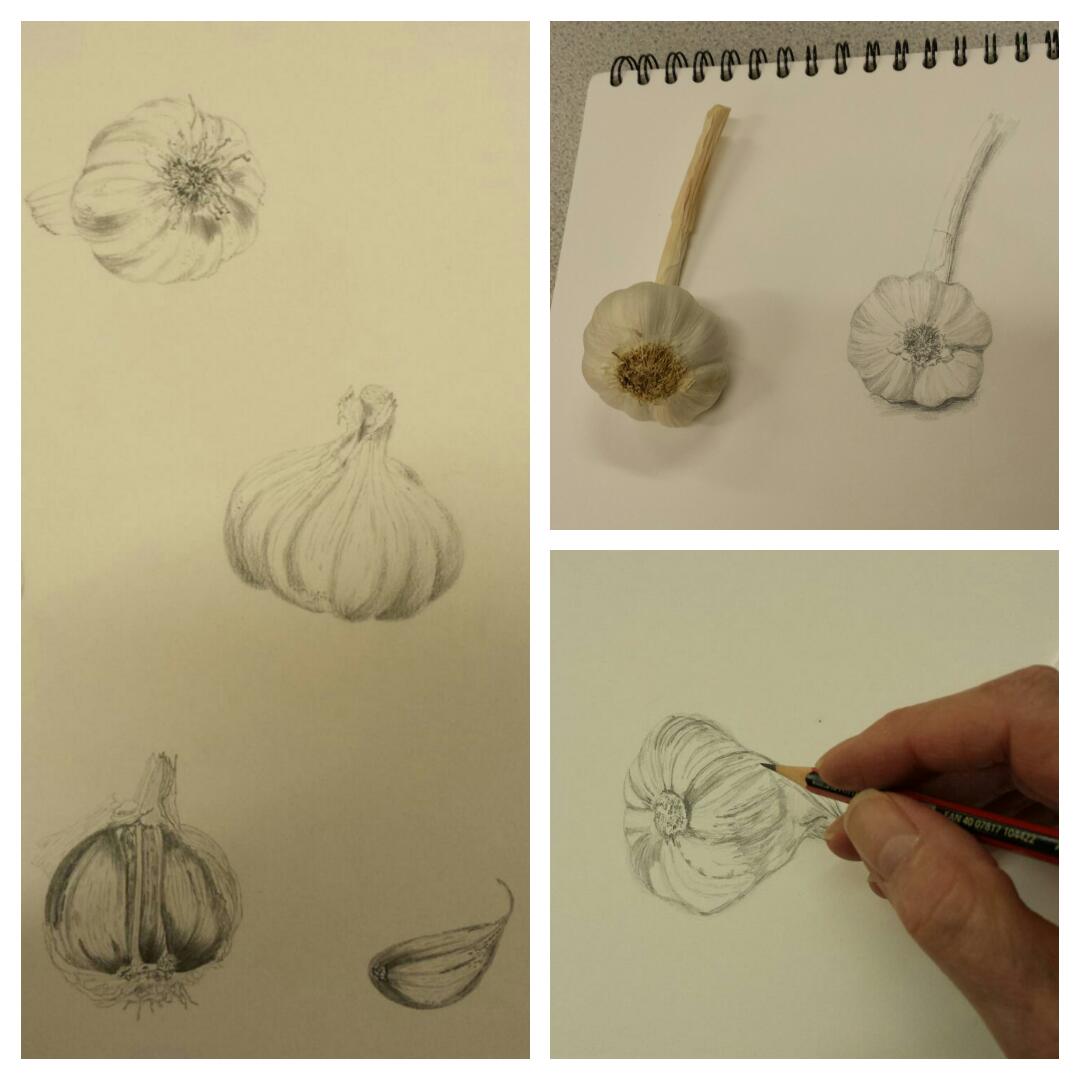
A previous week we worked on graphite drawings of garlic before going on to explore mixing neutral washes or 'botanical greys' to paint the same subject.

Back to this last week - it was free choice as to what the students brought in.  Quite a few of them started to work on small colourful squashes and a couple worked on these delightful variegated small aubergines / eggplants.

They may look a challenge, but hopefully seeing each stage develop will help you to understand the process.


The first stage was to draw the aubergine with a 2H pencil on hot-pressed watercolour paper.
Then a weak wash of New Gamboge (PY153) was applied.

The next colour to mix was the purple.  It had a red shade in there somewhere, so I decided upon DS Imperial purple with a splash of Perylene maroon (DS or W&N) in the mix.

To start to achieve the patterning I applied the paint in a downward stroke, sometimes softening the edges (especially where a highlight was occurring), but with some edges leaving them un-softened to portray the more defined patterns.

I decided that the original base wash of New Gamboge was too pale.  So once the purple areas were completely dry, I then painted another, slightly stronger wash of New Gamboge over the top and let it completely dry again.

The next stage was to strengthen the purple mix in intensity and build up more of the pattern in the same way as before, with a little less softening of edges taking place.

As this was a demo piece I only worked on part of the aubergine, so each step could be clearly seen in the same piece.
A further deeper purple mix was applied and to break up the striped effect, smaller dots and 'splodges' were painted on between the stripes.

Here you can see that the darker purple mix is applied just in very small areas and we are still retaining slightly lighter areas, which would be where the highlights are.
In all there were 4 layers of paint used in this demo piece (if you don't count the additional layer of New Gamboge).

The painting on the right is of another variety of small aubergine.

This one was painted for a class demo too and used in one of my You tube videos.


As I write this the blog has exceeded 60,000 pageviews !
Thank you so much everyone for your continued support.


Happy painting !

Wednesday, 11 February 2015

A new blog is born

As most of you would have read already on this blog, I have a new project getting underway which will focus on illustrating elements of ancient hedgerows. 

I am really excited by this project and as I type I am now at the Kingcombe Centre in Dorset for a few days to kickstart the fieldwork for the project.  I am very lucky to be supported by the Centre and also Dorset Wildlife Trust, who will be featuring an introduction to the project in their membership magazine.

 
Art & the Hedgerow will delve into many things about hedgerows.  Landscape history and ecology, conservation, tree species, and as well as that, showcase some of my art as part of the project.
 
 
To access the new blog you can click on the tab at the top of this page or the link in the above caption.
 
It would be great to have your company there too !
 
In the meantime, I will keep posting here, but the posts may be a little fewer, but hopefully just as interesting :)

Monday, 9 February 2015

A week of bits and bobs - oh and an Owl pellet too !

The time between finishing major pieces of work and before you start the next project, is always a chance to catch up on various bits and bobs and make future plans for artwork and such like.

The next project is starting fully towards the end of this week and I will be in Dorset to get that kick-started in an area that will hopefully provide me with lots of subject matter and inspiration.  The project is winter-based so I need to gather as much information as possible, in the form of field sketches, measurements and colour tests, then I can work on the pieces over the sunnier and warmer months of the year.

Packing up the kit ready to take away

The rest of the bits and bobs - Microscope, brush and pencil wallet, pallets, books, last of all will be my studio light as I need to make the most of my time away and work in the evenings

I'm not taking my studio box of paints, but have chosen certain colours that will suit this project  

The choice of colours was made once I had experimented with different mixes.  A few additional colours were chosen too

As well as getting ready for my next project, I have been enjoying teaching a weekly class at Alresford Art Society.  This art society is 50 years old and is located in a beautiful part of the Hampshire countryside.  It has been a real treat to teach different techniques in watercolour on a variety of subject themes, all based on the natural world.  

I had the delightful news this week that I will be teaching this very enthusiastic group of artists until June.  Now I am busy planning new themes for the Thursday morning sessions, several of which will incorporate print-making.  I will also be teaching the Friday morning group too for a few sessions in June.


Feather paintings and sketches from the artists at Alresford Art Society


The marine themed subject table at last week's class

Last week  I was given a Barn owl pellet.  As usual, I think outside the box a little and thought what a great sketch it would make for my natural history sketchbook.  It didn't quite go to plan as I got so involved in the dissection of the pellet and discovering what was in there.

First a little background information into what a pellet is.  Owls regurgitate pellets through their mouths.  They generally contain bones, hair and fur of the animals that the owl has eaten, these would not have been dissolved by the acid in the owl's stomach after the owl had eaten the small mammal whole.  Some pellets may also show signs of other food sources such as insects (body and wing cases), and seeds from fruit.

Owl pellets vary in size and colour dependant on the species they originate from.  Barn owls regurgitate their pellets close to where they roost, so as they often roost in farm buildings the pellets can be easier to find.  
YOU MUST NEVER DISTURB A BARN OWL IN A BARN WHERE IT IS ROOSTING - it may have young in a nearby box and may abandon them if disturbed.

Other owl species live in a variety of habitats and therefore their pellets are not always so easy to find.

The Barn owl pellet in one piece

Always wear gloves when dissecting a pellet.  I used tweezers and a scalpel from my microscope kit to pull the pellet apart.  It was only a few days old, so was still soft in places

This image shows all of the different bones that I found within the pellet.

The Field Studies Council produce wonderful and informative fold-out identification charts.  Luckily I had the one about Owls and their pellets.


I promise no more pictures of bones in the next blog post, hopefully beautiful winter views of the Dorset countryside.

Monday, 2 February 2015

Plants in their Landscape - do botanical paintings have a narrative ?

This question has been going around in my mind since I started a small series of paintings that I have called 'Plants in their Landscape'.  At the moment there are three paintings and I am hoping over time to add more to the series.

The three paintings below all detail specific plants in their landscape, each landscape area depicted being totally different from the others

'Botanical Survey - Teesdale Assemblage Trio' Moorhouse NNR, Upper Teesdale
  © Sarah Morrish 2015

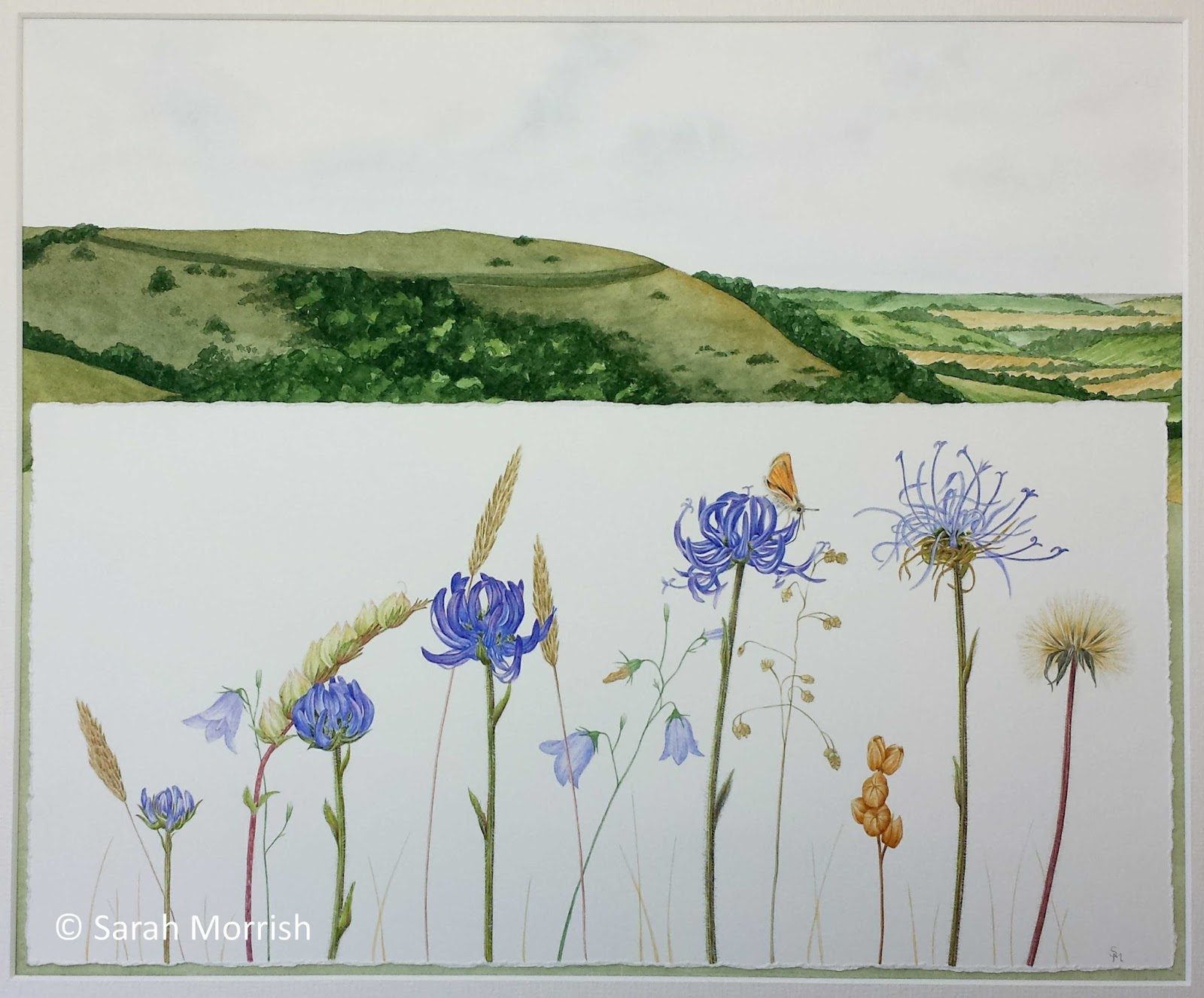
'Botanical Survey - Round-headed rampion' Old Winchester Hill NNR, Hampshire
© Sarah Morrish 2015

'Botanical Survey - Adder's tongue fern' Durlston NNR, Dorset
© Sarah Morrish 2015

Before we decide as to whether botanical paintings can have a narrative, perhaps we should have a look at the true definition of narrative art.

The Lucas Museum of Narrative Art in Chicago defines narrative art as 'art that tells a story. It uses the power of the visual image to ignite imaginations, evoke emotions and capture universal cultural truths and aspirations. What distinguishes Narrative Art from other genres is its ability to narrate a story across diverse cultures, preserving it for future generations'.

Good old Wikipedia says 'narrative art is art that tells a story, either as a moment in an ongoing story or as a sequence of events unfolding over time. Some of the earliest evidence of human art suggests that people told stories with pictures'. 

'Static images in any artistic medium do not naturally lend themselves to telling stories as stories are told over time (diachronic) and pictures are seen all at once (synchronic)'. 

So my initial thoughts are:
  • Botanical paintings that follow a sequence of growth, such as a bulb expanding and shooting, then a flower emerging, do most definately tell a story.  This particularly applies to Denise Ramsay's series entitled 'A Brilliant Life'
  • The above point can also be applied to those artworks that depict the seasons in sequence.  Perhaps four separate pictures that show a hedgerow through Spring, Summer, Autumn & Winter. 
I can hear some of you saying that the latter may not be considered a botanical painting as it is a scenic style of composition.

In my book botanical subjects do not always have to be depicted with no backgrounds or habitats in the picture.  Nowadays botanical artists are looking for new ways to present their botanical style of painting, and I am seeing more and more botanical paintings that tell a clear narrative.

The other thing to consider is where would plants be without their sometimes specialised habitats, and on a wider scale their landscapes ?

As my paintings above developed and came to life on the paper, what was I looking to achieve and did I have a clear narrative in mind at the beginning ?
  • Conservation often plays a part in my paintings, because of my working background in ecology and conservation.  This may not be obvious straight away, but as a viewer I want to raise awareness and get people thinking and asking questions.  'I wonder where that is ?' 'I think I've been there' 'What is special about those plants ?'.  They may be thinking and asking these questions before they have even looked at an explanatory label.
  • At the planning stage I had decided that the landscapes would all be from National Nature Reserves in the UK, and ones that I had visited, and the botanical paintings would include rare and uncommon plants.
  • In the painting of 'Botanical Survey - Teesdale Assemblage Trio', I wanted to show the large open stretches of land found at Moorhouse NNR and hopefully for people to get the sense of the small size of the plants and their fragility within the landscape. The three plants are Mountain pansy, Spring gentian and Bird's eye primrose.  The Spring gentian is only found in a few other places, one being the Burren in Western Ireland.  These three plants are part of a group of 20 internationally important plants called the Teesdale Assemblage.  They are examples of the first vegetation that grew in that area 10,000 to 12,000 years ago, after the last ice age.
  • 'Botanical Survey - Round-headed rampion'.  I spent quite a bit of time in 2006 surveying for this plant, helping a friend with the fieldwork for his dissertation.  It is found in several places along the South Downs and at Old Winchester Hill it grows on the slopes of the Iron Age hill fort.  As far as I was concerned the hill fort had to play a part in the painting, seeing as that is the main location for this plant on the site.  As well as giving a sense of history with the hill fort depicted, I also wanted to show the growth progression of the plant alongside some of the other plants and grasses that grow alongside it.
  • The field sketches for 'Botanical Survey - Adder's tongue fern' were completed in 2004, so this painting has been waiting a while to come to life !  The flower rich meadows set just back from the coast at Durlston NNR are full of all different plants and flowers and in the landscape for this picture I wanted to show the summer freshness of the green meadows and surrounding vegetation, alongside the green of this unusual fern.

So, I am not stating that all paintings should have a narrative, but hopefully I have raised your awareness of how your botanical paintings can tell a story.

These paintings are being submitted with two others for the Society of Botanical Artists Exhibition in April.  The theme of the exhibition is 'In Pursuit of Plants', hence why I have added 'botanical survey' to the title of each  There is no guarantee that they will be accepted but I am keeping my fingers crossed !

Special thanks must go to David Glaves, an Ecologist and fabulous photographer, who supplied the photo reference for the Moorhouse NNR landscape.  At the time of visiting the reserve in 2007 I was too busy sketching the plants and taking photos of them, so I forgot the landscape !

Please remember that if you are trying to source reference material online, do contact the photographer if you are wishing to use their image for any purpose.

Happy Painting !

Friday, 16 January 2015

Drawing & Painting Nature (iv) - Up close and personal with Winter twigs !

I may well have written a post about winter twigs on the blog before, but it's that time of year again when my eyes are peeled looking at trees when I pass them, to see how the buds are coming along.

This time, with the help of some amazing close-up photos I can show you 3 tree species and their winter twigs and buds in minute detail.

It may seem that trees are more difficult to identify in the winter months, but rest assured it can be an easier task than you think.  If it is an isolated tree in the landscape you can quite often stand back and have a look at its overall shape, but if trees and shrubs are often bunched up together such as in a species rich hedgerow, it can be more difficult to tell.

The painting below is an old one called Twigs of Kingcombe Hedgerows.  It is an old favourite and always raises much discussion about the variety of colours and textures, as well as beauty in winter twigs.  It also shows that if you look carefully you can soon tell the differences and start to identify trees on your winter walks.

Can you tell what species they are ?

© Sarah Morrish.  Twigs of Kingcombe Hedgerows

For my latest project I do really have to get up close and personal with winter twigs and the characteristics of each tree species.  I need to know every single bit of detail, especially of the buds, as I am going to be producing enlarged paintings of the buds themselves.  They are not going to be HUGE reproductions of the buds, but probably 5-10 times their actual size dependant on the tree and shrub species being studied.  So, onto my research.

A photographer friend came for a visit with his super macro lens and carefully went to work in capturing so much detail.  I could see the detail under microscope but I also needed digital images for reference too.


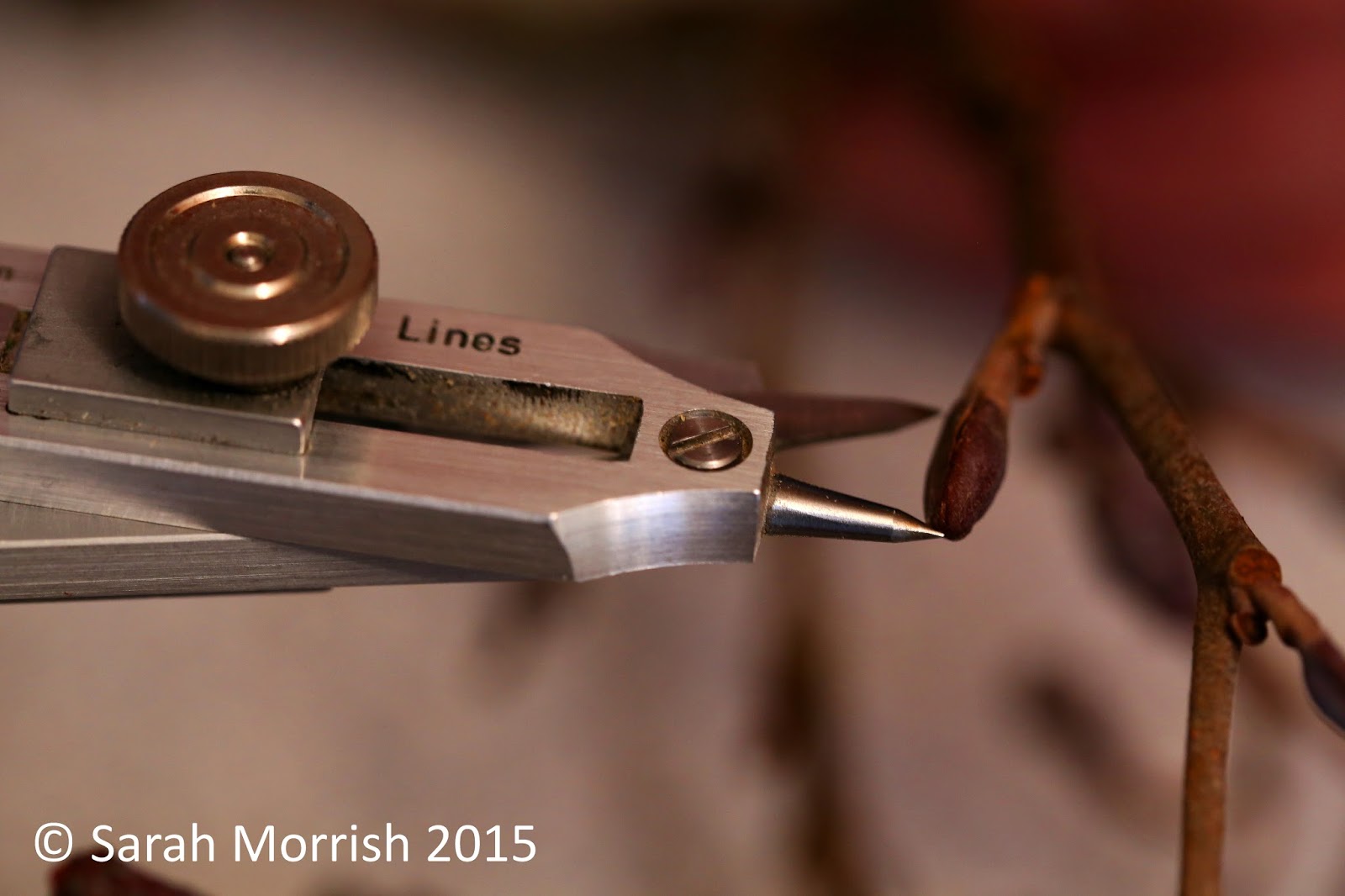
Here I am measuring the length of an Alder bud

An Alder bud up close

The female cones of Alder become darker and shed their seeds during winter

The male catkins of Alder, new this year, which will eventually turn more yellow and pendulous

The young twigs of Dogwood can appear slightly downy, although they are smooth to the touch.
As they age they become more shiny and redder. 


I was amazed with what I saw through the microscope.  Looking at them with the naked eye you just couldn't see the 'hairyness' of the young buds and bud scales.

The female flowers of Hazel emerging from their buds.

An enlarged version of the bud.  Underneath my hand you can just see the scale bar of the actual size of this bud and flower.  Here I am using a sable spotter brush

The edges of the bud scales often have a fringe of pale coloured hairs in places.  Along with this the twigs can often be quite hairy.

The beauty of the male catkins of Hazel.  They slowly open and release the pollen which then makes its way in the breeze to the female flowers

In this image you can clearly see the lenticels on the twig.

I hope you have enjoyed this close up view of winter twigs and their buds.  This will be an ongoing project, so I am sure there will be plenty more blog posts showing further features of other tree and shrub species.

If you would like a further read of other news, my winter newsletter is now published.  If you click on the link at the top of the right hand column, you can view and read a PDF of it.

There is also a link below that, that will take you to the page on the Natures Details website of the Summer School courses coming up in 2015.

Monday, 5 January 2015

Drawing & Painting Nature (iii) - with all good intentions !

Wishing everyone a very happy and creative new year !

The change of routine over the Christmas break was a welcome respite from the intensity of last term and the lead up to Christmas.

I didn't abandon my creativity completely, and spent some time trying to finish a couple of paintings for the SBA exhibition coming up in April.  Still a bit more to go until I can reveal them in their entirety.  One thing I did want to do was to get outside and do some sketching at Titchfield Haven Nature Reserve.

I have spoken of this wonderful place before on this blog.  One end of the reserve overlooks the Solent towards the Isle of Wight and you have the reserve on one side of the road and the beach on the other.  At low tide I love exploring the shallow pools and scavenging for treasures to sketch along the strandline.

We had planned the day of our trip carefully, ensuring that we would go at low tide when some of the wintering birds may have been feeding on the scrapes area of the reserve.  The weather was icy cold and in the morning the reserve and surrounding area were covered in a mystical mist, that soon disappeared once the sun tried to push through.


Ice topped reeds on the reserve

Rather than take my full sketching field kit I had just packed an A4 cartridge pad and an F pencil.  I soon realised that I wouldn't be brave enough to sketch in the icy cold conditions, and I soon became mesmerised by looking through the camera lens and capturing what I saw in that way !  Nevertheless I came away with several images that I can incorporate into artwork.  


Wrapped up warm against the chill


Frozen lichen


A very distant view of a Kingfisher.  We watched it from one of the hides for about 5 mins, fishing from the 'bendy' reeds


Defrosting seeds and 'fluff' on a majestic Bullrush

The absolute highlight of the day was seeing a flock on Bearded tits move around the reserve.  These are birds that I have always wanted to see, I certainly wasn't disappointed !  


The first more distant image of the Bearded tits.  Despite not getting close-up images at this stage, it is always a delight to just stand and watch them and observe their feeding and communication behaviour.

I was in for a surprise after having a warming cup of tea in the cafe.  As we came out the Bearded tits had moved round to a point where you could really observe them closely, and the images below are the results.

If you would like to find out more about these stunning birds the RSPB has a good information page on the species.


Male (left) Female (right)


So the moral of this story, is not to become too bothered if field-sketching does not occur.  Just enjoy your time watching and observing the wildlife.

Meanwhile, in the studio I have had two visitors over the Christmas break.  Two Little owls on loan from the museum service.  My aim was not to complete a finished painting of them, but use them as reference for a study page in my natural history illustration sketchbook.


Little owl - work in progress.
Graphite pencil on cartridge paper.


Well, I hope you have enjoyed the first post of 2015.

Soon I will posting information about the courses and workshops that I will be teaching in 2015, along with exhibition dates too.

Can I just politely remind blog visitors, that all images on this blog are protected by copyright and may not be copied or reproduced in anyway.  I do not allow any images to be used on Pinterest.

Many thanks, happy painting !  Sarah