Tuesday, 22 May 2012

Latest sketches & Early Purple Orchid - Devon

Just a quick blog posting before we head to Skomer this morning.

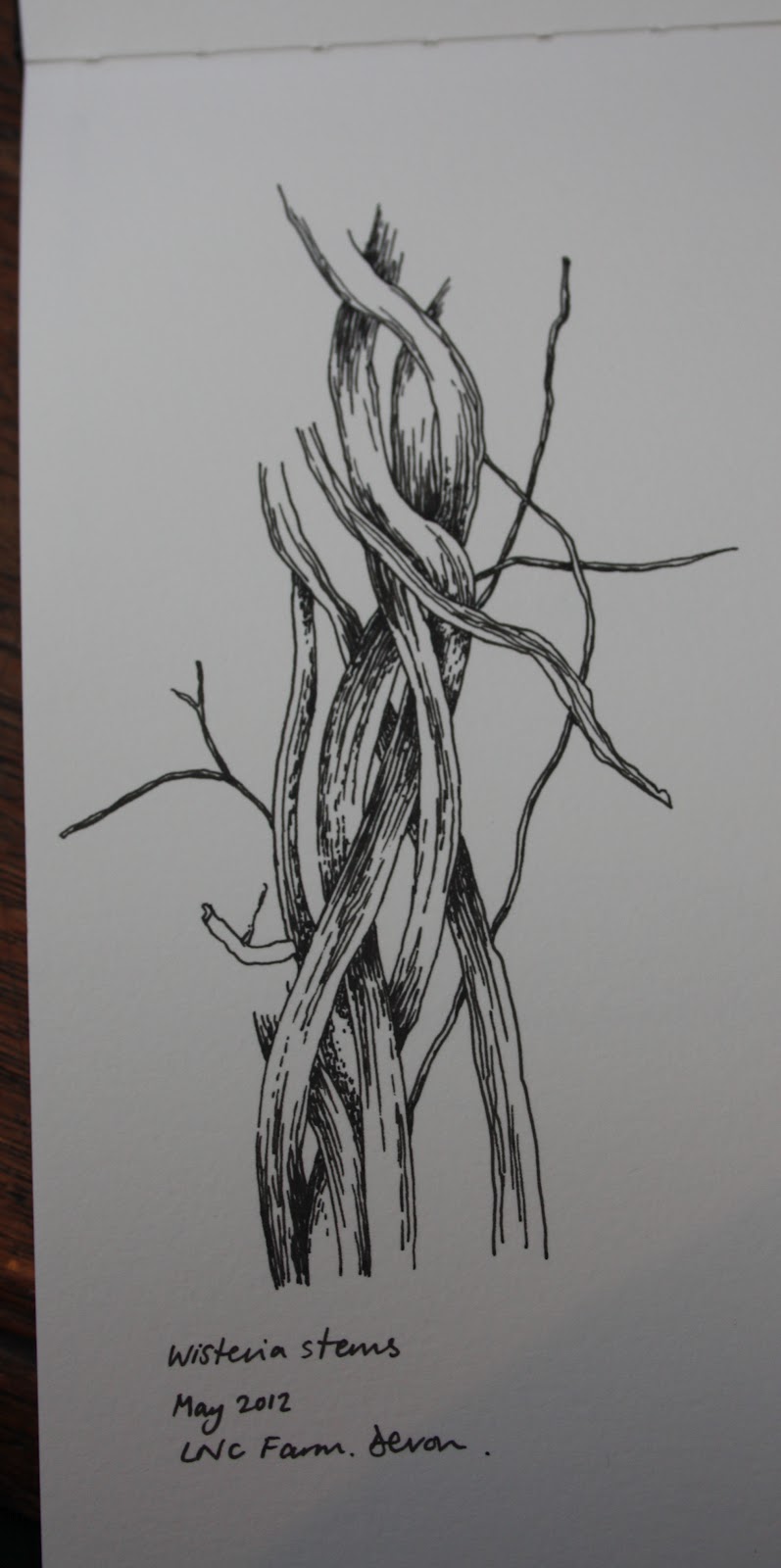
These sketches were completed in Devon last week and in addition there are some images of an Early Purple Orchid painting that I have started and will finish when I get home.

Primrose

Wisteria stems


Early Purple Orchid painting - in progress

Friday, 18 May 2012

A trip in Timothy, Devon Hedgebanks and Twisted Sweet Chestnuts

Blog post written on 16th May:

Well, after an abscence I finally have some worthy sketches to post on the blog.  Painting has been hard to establish over the coming weeks, but finally now I am in wonderful Devon, new inspiration has given me a great kick-start.

We are staying on a friend's farm for a week and it is the midst of the Devon countryside surrounded by glorious hedgebanks that are starting to be swathed in wild flowers - more of those later.

The first sketch that I completed was of a Marsh marigold that was growing by the edge of the river.  I love the venation pattern on the leaves but wasn't brave enough to draw a large leaf.

The sketchbook I am using is a 'Moleskin' watercolour journal, with slightly off-white paper with a very slight texture, that I wouldn't quite call cold-pressed.  I had always thought that there was some 'snobbery' surrounding this make of journal, but I can now see their appeal. 
The paper is similar in colour to Fabriano Artistico natural white, which means that for reference purposes I do not need to make many alterations in terms of paint colours.  It also takes a certain amount of moisture which is great for using wet in to wet, to lay down initial washes of colour.

We ventured out this morning with our friends to visit a beautiful estate near Collumpton that is being restored.  The parkland is stunning and there is a line of Sweet chestnut trees that used to line the original driveway many, many years ago.  At a guess the trees must be nearing 300 years old and virtually all of them are still in full growth.  There are many cracks and fissures in the trunks and the varying patterns of the bark twisting up through the trees is amazing.  My mind is buzzing with ideas for paintings !  Some images of the trees are below:


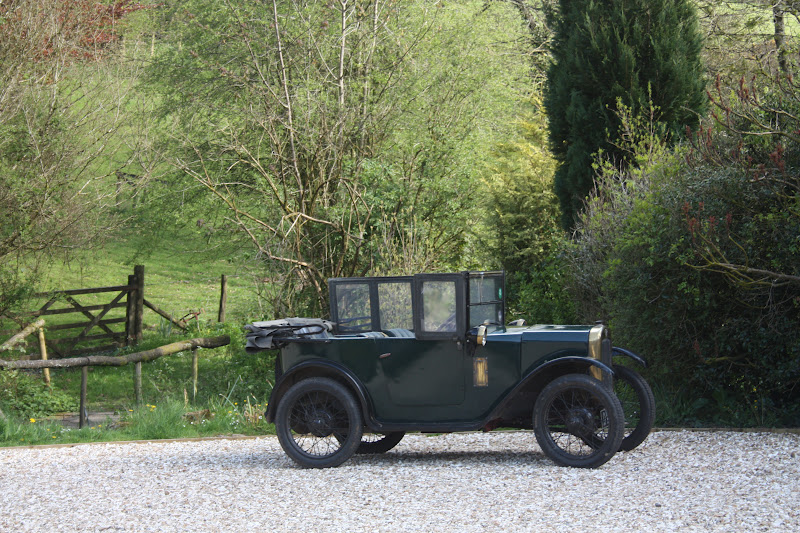
We visited a local village pub for lunch and my journey was in an Austin 7 that is 83 years old!  My solid body shape took up rather a lot of room and I hung onto the passenger door in the hope that I wouldn't fall out !  The car is called 'Timothy' and is looked upon rather affectionately.  As the journey back to the farm was up some rather steep hills I declined the journey as there was the risk that I and the car wouldn't make it !!


The wild flowers in the hedgerows and banks seem a bit behind down here compared to in Hampshire.  Saying that though, there were swathes of Early Purple orchids in the hedgerow verges today, seen as we whizzed past them in Timothy.

Nearer to the farm the flowers are starting to open and the narrow lanes and steep banks provide a wonderful micro-climate for these plants to grow in, along with ferns, mosses, lichens and later in the year fungi.

Spot the plants and flowers in the montage below:


More sketches to complete tomorrow, then off to Pembrokeshire at the end of the week to celebrate our first year of marriage and then another special visit to tick off of my 'wish-list' - a two day trip to the island of Skomer to photograph Puffins and hopefully do some more sketching.  Cheerio for now!

Friday, 27 April 2012

Frustrations as a Tutor - budget art materials


I love teaching natural history illustration and also botanical art, but in recent times I have become  frustrated by the use of cheap art materials, particularly so-called watercolours, that students purchase from 'budget' shops and such like.

From a student's perspective and especially as a beginner, the wealth of art materials available can be over-whelming and somewhat expensive if choices and purchases are not made wisely, and also of course prior to gaining the knowledge of what actually is required for a workshop or course.  It is also easy to be persuaded by cheaper alternatives, which often carry a description that creates a false impression of what can be achieved by the materials.

I know it sounds as though I am on my 'soap-box', but this seemed an appropriate subject for the blog, and if you have any further comments or suggestions, feel free to use the comment facility below this post.

At some of my art workshops I often teach beginners or individuals who are returning to painting after a gap of some years.  A workshop materials sheet is always distributed before hand with suggested colours of paint (preferably artist's quality) and the size brushes required (with a good point on each), along with any other materials needed.

The problem seems to be with the paint and brushes.  Students are often excited to use new art materials and usually progress well during the early stages of drawing their subject.  So often disappointment comes once colour is applied.  The method of creating washes is not an issue, but the poor quality of paint and brushes can render the theories of paint application and colour theory to the bin !  

Budget mass-produced watercolours usually contain very poor man-made pigments and a huge amount of binder.  They are terribly opaque and perform more like gouache or poster paint.  In some cases the principals of colour theory are just not possible to demonstrate.  The colours can be separated by eye into warm and cool colours, but once colour-mixing begins virtually every colour created ends up being 'muddy' with no transparent qualities.

I often let students use my watercolour paints, so that they actually experience the difference of using good quality paints.  Once this happens, so often students are converted and then gradually build up a palette of artist's colours, or if not affordable good quality student grade watercolours from well known manufacturers.

Over the last couple of weeks I have been looking at ways to help solve this problem.  My solution is that I am going to have 4 paint kits for students to use, for only a little extra cost on top of the normal workshop fee and they can use these whilst at the workshop or course.

The paints that I have chosen to use in these kits are Winsor and Newton Cotman Student watercolour paints.  I realise that these are not artist's quality, but they are a good, affordable starter paint to use.  The colour palette includes colours that I used when first starting to paint many years ago.  The one exception is 'purple lake', which I have chosen instead of 'permanent magenta', which is not available in this range.

Lemon yellow
Cadmium yellow
Cadmium red
Permanent rose
Purple lake
Ultramarine
Cobalt blue
Cerulean blue
Raw sienna
Burnt sienna
Sepia

I am also going to have a selection of brushes for students to use with these kits.  These will be Pro Arte Connoisseur, which are a sable-prolene mix and are very reasonably priced.

Watch this space for further news of these paint kits and I will also post some pictures of them in the near future.

Friday, 6 April 2012

Owls and more !

Apologies for not posting in a while, plenty of things have been happening and the 'juggling' still continues.

Not much painting has taken place.  I did start a picture of a Magnolia growing in our garden, but I seemed to have left it for too long and just can't get back into it.  It may be a case of leaving it on the drawing board and coming back to it next year.


I taught a very successful and happy lino-print workshop on the 16th March for the Society of Floral Painters.  The atmosphere was great and I think it was quite refreshing for many of us, as we all work in slightly different styles from a painting perspective, but print-making was a whole new world!  I have posted a couple of photos below, but more of a selection can be found at:
www.society-of-floral-painters.blogspot.com


The main thing that has been taking up our time is developing our garden in the recent spell of very warm weather.  It is only a smallish semi-urban garden, south-facing, but with a virtually non existant lawn.  We decided to take up the lawn and replace it with chippings and we have also increased the size of the borders significantly.  That way we can plant a selection of plants that will attract bees, butterflies and other insects over the coming months.

The workshops with the Wildlife Trust have been well supported this year and the next one on the 21st April has 8 students on it.  So I look forward to meeting all of them to paint features of Spring trees.
Workshops and courses are detailed below and you can also download a PDF of the leaflet from my main website.


Derek and I had a great time at the Hawk Conservancy Trust near Andover, the other week.  We had an 'Owl experience' session and got to handle several species of owl.  They are all magnificent, but my favourites do have to be the Tawny and Barn Owl :)


A Spectacled Owl

Well, what next?  Definately more of a focus on my artwork.  In a few weeks I will be retiring from 20 years plus in childcare.  It used to be my main career before I went into ecology and in recent years I have taken it up again alongside my art career.  Osteoarthritis in my knees has forced me to stop, so I am looking forward to a new direction and starting my Botanical Art teaching role at Peter Symonds ACE in September.

Next weekend I will be at the Bursledon Brickworks Industrial Museum Craft and Heritage Fair, with a few pieces of artwork on display and some new editions of my lino-prints to sell.  I look forward to seeing some of you there !  In a few weekends time I will be visiting the Society of Botanical Artist Exhibition in London - really looking forward to it.

Sunday, 26 February 2012

'A Brush with Nature' workshop - Testwood Lakes

I have always loved teaching this workshop and it seems to be quite a popular one over the last few years that I have taught it - mainly with the Hants and IOW Wildlife Trust.  This year we were at Testwood Lakes, a reserve managed by the Trust on the western side of Southampton.


It was a beautiful day with the sun streaming through the windows, but alas we were so engrossed in the natural treasures inside that we didn't venture out.

In the classroom we were lucky enough to have the use of several preserved birds and there were other delights such as an intact wasp's nest with its subtle colours and layers pierced at times by twigs from a vine, that had previously supported it.  My absolute favourite was a Harvest mouse nest, which I just cannot wait to draw and paint.  I have some reference photos previously taken at Slimbridge of some Harvest mice, so I hope to combine the two subjects - maybe to exhibit at the Marwell Exhibition in October, we shall see.

Back to the workshop - I had five lovely students (Roger, Mary, Eve, Clare and Jaen), who were very enthusiastic and once over the initial trepidation produced some stunning work.  I was pleased that we focused on the importance of drawing, particularly in the approach that I take to natural history illustration.  Quite often, when time is limited, drawing can sometimes be slightly forgotten about in the rush to apply colour.  But in todays case, everybody really put the effort into the drawing as well as the colour - so well done :)  Photos follow below.

By then end of the day I think everbody felt satisfied and with tired eyes and beautiful artwork we all headed home.


Eve concentrated on drawing a piece of driftwood, portraying the varying depths of tone and the grain / texture of the wood.  Once completed she added a pale wash of brown watercolour across the work.  This helped to set the graphite on the page and also gave a degree of warmth to the subject.


Clare completed some tonal studies of natural objects, first concentrating on a bleached white shell and differentiating between the fine lines on the shell and the overall tone of the subject.  She then did some lovely delicate studies of the maple seed above and features of the Tawny owl model in the classroom.


Jaen loves colour and she really ensured that the drawing was accurate before she added her array of colours.  We looked at ways that she could portray the irredescence of the inside of shells using watercolour, without having to use white paint as the base colour.  It's amazing what colours you can see when you really take the time to look at something !


Mary initially worked on a small study of a Physalis fruit and whilst letting the layers of watercolour dry, she started to draw this sheep's horn.  It had ridges radiating down from the top to the narrow end and she was able to portray these without drawing every single one, but still giving an accurate representation of the subject.


Roger really wanted to explore the qualities of different grades of pencil and to concentrate on what can be achieved, whether it be making a few lines to represent a subject or completing a more detailed drawing but using some broad pencil movements.  He achieved both, but particularly the latter, using a model of a Coot and drawing it with a softer grade of pencil such as a 6B.


Friday, 17 February 2012

New website

At last my new website is up and running and is live as from now !  Hopefully there are not too many glitches, although the 'contact page' is not yet active.

Enjoy and the address is:

www.natures-details.com

Tuesday, 14 February 2012

New Year, new approach !

The allium lino-cut design has been put on hold this week as I have got my teeth into some more acrylic work.

This I tried for the first time last year on a smaller scale, but now I am working on a piece which is 40cms square.  The support is a natural linen canvas already primed (from Pebeo), and I love to keep the colour of the canvas as the background colour rather than cover it in pigment.

I suppose what I am trying to do is to take botanical portraiture in a different direction for me.

The subject is a cluster of Hornbeam seeds, that I found still hanging from a tree.  As some of you know, I love to paint brown subjects and this is definately proving to be a challenge !

I'll keep you posted on the progress, but in the meantime here are some initial images to keep you going.